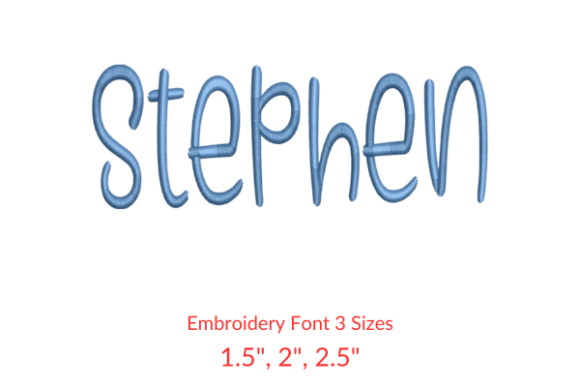
Stephen Font Embroidery Review
As a professional embroidery designer who has spent years turning digital concepts into tactile brand assets, I approach every new embroidery file with a mix of creative enthusiasm and practical skepticism. When evaluating a design for small business merchandise, branded patches, or uniform accents, the font is often the most critical element. It dictates legibility, perceived value, and overall brand identity. Today, I am reviewing the Stephen Font, a machine embroidery design that promises to help personalize designs for names, dates, or quotes on any fabric. This review focuses on how this specific typeface performs in real-world commercial applications, from Etsy seller branding to boutique merch.
First Impressions: Visual Personality and Professionalism
The name "Stephen" suggests a classic, perhaps slightly traditional feel, but without seeing the exact vector path, we must rely on the description’s promise of high quality and versatility. In the world of commercial embroidery, fonts fall into distinct categories: bold and industrial, playful and rounded, or elegant and script-like. For a product described as suitable for writing names, dates, and quotes, Stephen Font likely strikes a balance between readability and character.
For small business owners, the first impression of a font determines whether it feels like a premium brand asset or a generic clip-art addition. A successful brand identity requires consistency. If Stephen Font offers clean lines and balanced spacing, it can elevate a simple tote bag design into a sophisticated piece of custom apparel. However, if the font is overly decorative or thin, it may struggle to hold its shape during the stitching process, leading to a less polished finished product.
Real-World Business Applications
The true test of any digital embroidery file is how it translates to physical goods. Here is how Stephen Font might perform across various popular small business categories:
Embroidered Patches and Brand Badges
One of the most profitable niches for crafters is creating custom patches. Whether for a local café, a handmade shop, or a creative studio, patches serve as mobile advertisements. Stephen Font could work exceptionally well here if the lettering remains clear at smaller scales. Imagine a bakery using this font to stitch their logo onto denim jackets or leather aprons. The font’s ability to handle names and dates makes it ideal for personalized gift items, which command higher prices in the handmade product market.
Staff Uniforms and Workwear
For businesses looking to unify their team, apron embroidery and cap embroidery are staples. Staff uniforms need to be professional yet approachable. If Stephen Font has a friendly yet structured aesthetic, it can enhance customer trust by presenting a cohesive visual image. It is crucial that the font does not look too casual for a corporate environment, nor too stiff for a relaxed boutique setting. Proper thread color contrast against dark uniforms is essential here to ensure the text pops.
Tote Bags and Event Merchandise
Tote bag design is a perennial favorite for event merch and conference giveaways. Because these bags are carried around publicly, the typography becomes part of the city’s visual landscape. Stephen Font, if designed with good kerning (spacing between letters), will remain legible even when viewed from a distance. This visibility increases brand recognition and engagement among potential customers who see the bag in use.
Strategic Use Cases and Limitations
While Stephen Font shows promise, no single design fits every scenario. As an experienced designer, I advise caution in specific applications where technical limitations may compromise the aesthetic.
- Small Patch Sizes: If you intend to stitch Stephen Font on patches smaller than two inches, test the resolution carefully. Thin strokes may fill in, making the text illegible.
- Curved Surfaces: On cap embroidery, text follows a curve. Ensure the font has enough x-height (the height of lowercase letters) to remain readable when distorted by curvature.
- High Stitch Density: Dense fonts can create stiff, uncomfortable fabric textures. For items worn directly against the skin, such as t-shirts or lightweight aprons, a lighter stitch density is preferable to maintain comfort.
- Textured Fabrics: On rough materials like burlap or heavy canvas, fine details in the font may get lost. Always inspect spacing closely when working with textured fabrics.
Impact on Brand Identity and Customer Trust
In the competitive landscape of small business merch, details matter. Customers often judge the quality of a brand by the quality of its embroidery. A sloppy stitch job or an unreadable font can undermine the perceived value of the product. Conversely, a well-executed embroidered patch featuring a strong typeface like Stephen Font signals professionalism and attention to detail.
This visual consistency builds buyer engagement. When a customer sees a name or date stitched clearly on a product, it creates a sense of personalization and care. This emotional connection is vital for Etsy sellers and independent designers who rely on repeat customers and word-of-mouth referrals. By choosing a font that aligns with your brand’s voice—whether that is rustic, modern, or classic—you reinforce your story before the customer even reads the label.
Practical Designer Notes for Production
Before committing to bulk production, follow these essential steps to ensure success with Stephen Font:
- Test in Black and White: Remove color distractions to evaluate the shape and weight of the letters. Does the font have enough contrast between thick and thin strokes?
- Check Small Scale Legibility: Resize the design to the dimensions of your intended patch or logo. Can you still read the names or quotes clearly?
- Review Thread Color Contrast: Light threads on dark fabric or vice versa are easier to read. Avoid low-contrast combinations like navy on black.
- Inspect Spacing: Ensure there is adequate space between letters to prevent them from merging during stitching.
- Confirm Hoop Size: Verify that the design fits within your standard hoop sizes to avoid unnecessary trimming or re-hooping.
- Test on Real Fabric: Digital mockups can be deceiving. Always stitch a sample on the actual fabric you plan to sell to check for puckering or distortion.
- Use Proper Stabilizer: The right stabilizer prevents shifting and ensures crisp edges. This is especially important for delicate fabrics.
- Create a Printable Mockup: Show clients a realistic preview before production. This manages expectations and speeds up approval.
- Compare Design Assets: See how Stephen Font pairs with other elements in your collection. Does it complement logos or icons?
- Confirm Commercial Licensing: Most importantly, verify the licensing terms. Ensure you have the right to use Stephen Font for commercial embroidery projects, including selling finished goods.
Final Verdict
Stephen Font appears to be a versatile tool for the modern embroidery business. Its suitability for names, dates, and quotes makes it particularly valuable for personalized gifts and branded merchandise. By understanding its strengths and limitations, small business owners and designers can leverage this machine embroidery design to create products that stand out in a crowded market. Remember, the best embroidery designs are those that solve a problem while enhancing the brand’s visual narrative. Test thoroughly, plan carefully, and let the quality of your stitches speak for your brand.